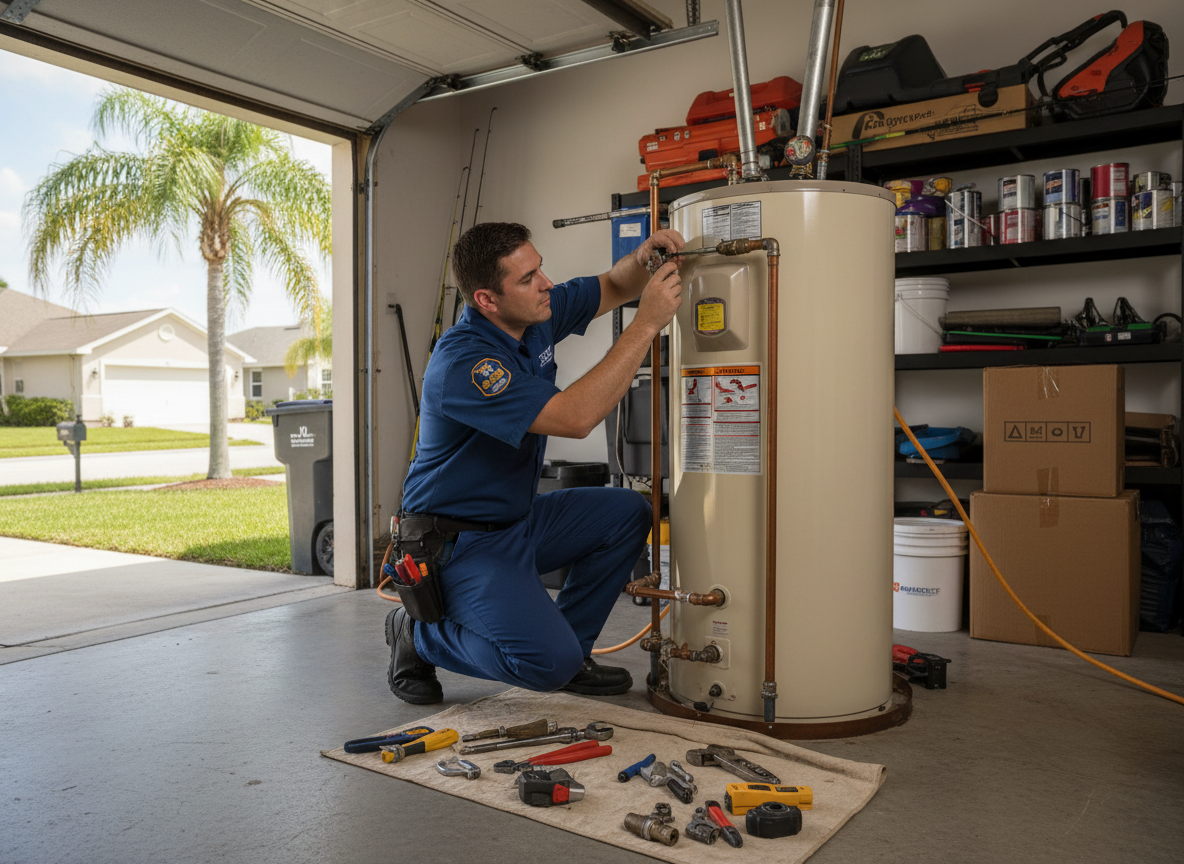
Wellswood's mid-century block homes are built for a climate that punishes buildings, and their garages and utility alcoves are where most of the neighbourhood's water heaters sit. A garage location has one clear advantage: a leak announces itself on concrete instead of soaking into a ceiling.
It has a disadvantage too. A garage in Tampa reaches high temperatures for much of the year, and a gas unit drawing combustion air from that space behaves differently than one in a ventilated closet. Venting, combustion air and the condition of the flue are checked with that in mind.
Most of the repair work here is familiar: elements and thermostats on electric tanks, control valves and thermocouples on gas, sediment on both. The location simply makes the job easier to inspect and the leak easier to spot early.
Many Wellswood homes were built with irrigation and softener loops added later, and those additions sometimes share a shutoff with the water heater or sit on the same pressure-reducing valve. When a relief valve is discharging, the whole arrangement is worth checking rather than only the heater, because a shared regulator can be the real source of the pressure.